
Relational Database CDC → Amazon S3(Near Real-Time Ingestion)

AWS • CDC • Intermediate • Healthcare

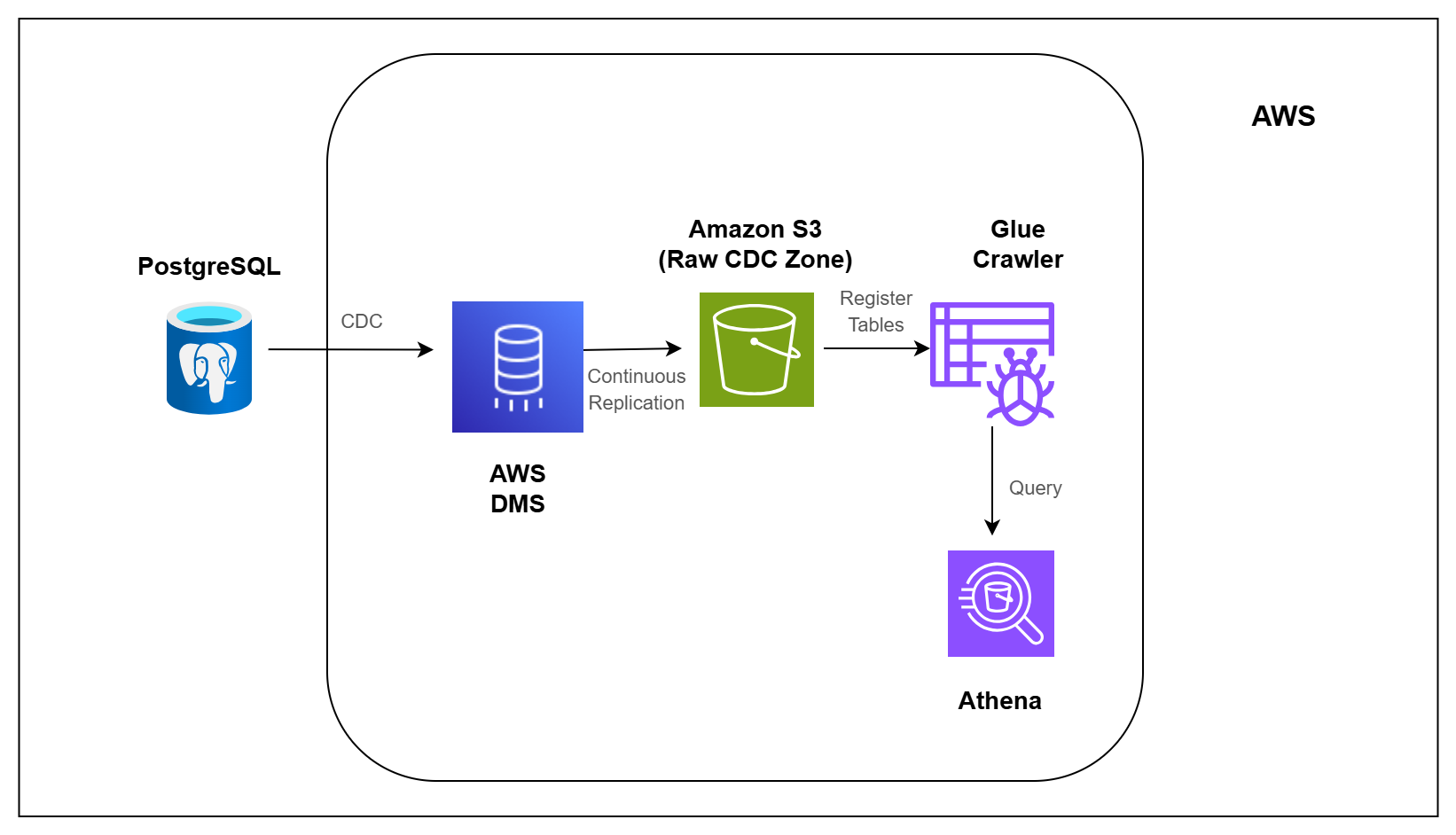
Architecture Diagram

Overview

In the previous pipeline, data was loaded into Amazon S3 using scheduled batch jobs. While this works well for many use cases, some systems require data to be available much faster.

Instead of waiting for the next batch run, organizations often capture changes directly from the database as they happen and continuously move those changes into the data lake.

In this pipeline, you will build a Change Data Capture (CDC) pipeline using AWS Database Migration Service (DMS). As records are inserted, updated, or deleted in PostgreSQL, the changes are automatically captured and written to Amazon S3.

You will also simulate real healthcare events such as new lab orders, lab results, medication updates, and billing charges to see how CDC pipelines behave in real-world systems.

What You Will Build

  • Configure PostgreSQL for Change Data Capture (CDC)
  • Create AWS DMS source and target endpoints
  • Configure a DMS replication task
  • Capture inserts, updates, and deletes from PostgreSQL
  • Continuously load database changes into Amazon S3
  • Validate CDC events arriving in the data lake
  • Simulate real healthcare transactions and observe CDC behavior
  • Understand how near real-time ingestion differs from batch ingestion

Tech Stack

PostgreSQL • AWS Database Migration Service (DMS) • Amazon S3 • AWS IAM • PostgreSQL Logical Replication

Learning Outcomes

After completing this pipeline, you will be able to:

  1. Implement Change Data Capture (CDC) pipelines on AWS
  2. Capture inserts, updates, and deletes from relational databases
  3. Stream database changes into a cloud data lake
  4. Configure AWS DMS replication tasks and endpoints
  5. Validate and troubleshoot CDC pipelines
  6. Understand when to use CDC instead of batch ingestion